
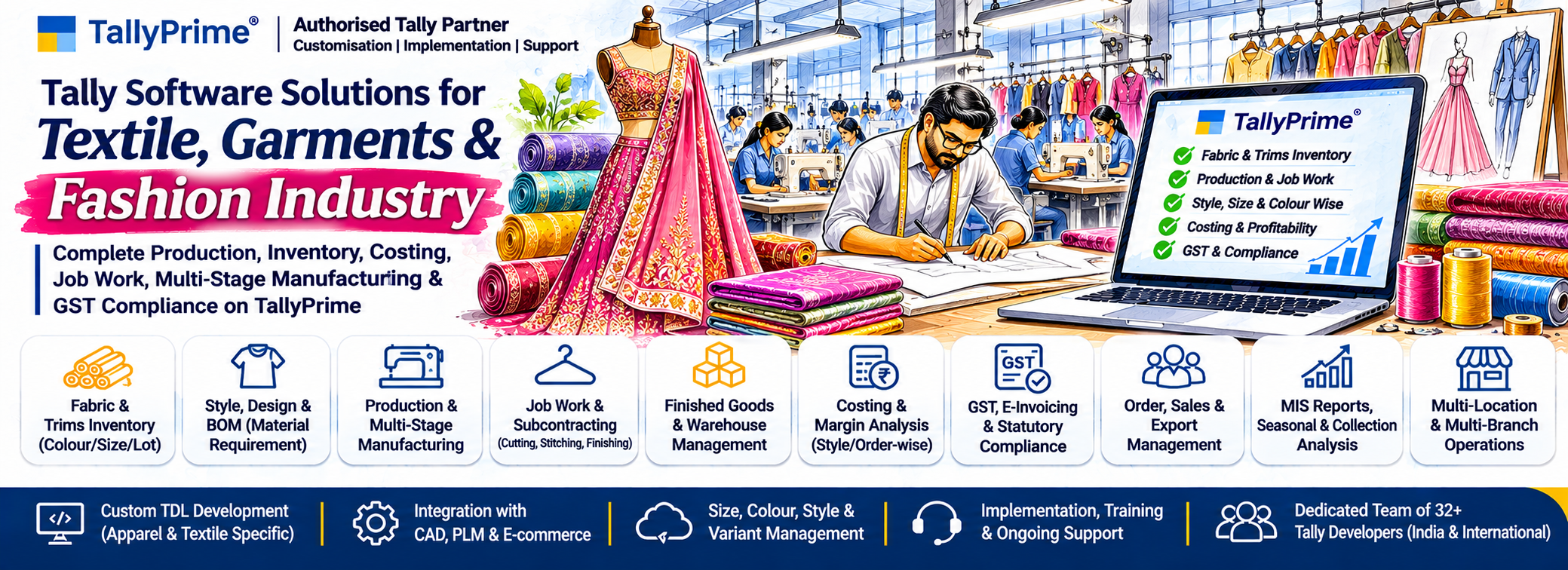
Tally Software Solutions for Textile, Garments & Fashion Industry
Introduction
The textile, garments and fashion industry is one of the most diverse manufacturing and trading sectors. It includes textile mills, fabric manufacturers, garment factories, clothing brands, fashion designers, wholesalers, exporters, boutiques and retail businesses.
Businesses in this industry deal with a wide range of materials and finished products, including yarn, fabric, garments, accessories, trims, buttons, zippers, labels and packaging materials.
Unlike many other industries, textile and garment businesses frequently manage products with multiple variations. A single garment design may be available in different sizes, colours, fabrics and styles. Similarly, a textile manufacturer may purchase yarn, produce fabric in different shades and widths, and sell it according to metres, kilograms or rolls.
Managing these variations through manual records can become difficult as the business expands.
Manufacturers need to maintain accurate records of raw materials, production orders, fabric consumption, cutting wastage, stitching, finishing, inventory, customer orders and dispatches.
TallyPrime can provide an accounting and inventory foundation for textile and garment businesses. Its accounting, inventory, purchase, sales and manufacturing-related features can be configured to support many common business processes.
For specialised requirements, additional TallyPrime customisation can be developed for size-colour matrices, fabric rolls, garment production, job work, cutting plans, order tracking, costing, barcode labels and industry-specific reports.
At TallySolution.net, we provide TallyPrime customisation and TDL development services for textile manufacturers, garment factories, fashion businesses and clothing distributors.
Our dedicated team of more than 32 developers works across Delhi, India and internationally, developing customised business workflows according to operational requirements.
Why Textile and Garment Businesses Need Customised TallyPrime Solutions
Textile and garment businesses often need to manage several interconnected processes:
Raw material purchasing
Yarn and fabric inventory
Fabric roll management
Colour and shade tracking
Size-wise inventory
Style and design management
Cutting and stitching
Production planning
Job work and subcontracting
Fabric wastage
Finished garment inventory
Customer orders
Wholesale and retail sales
Export documentation
Accounting and GST reporting
For example, a garment manufacturer may produce a shirt in five sizes and four colours.
This creates 20 possible product variations for a single design.
If the manufacturer produces 100 pieces of each variation, the business must maintain accurate stock quantities for each size and colour combination.
A customised TallyPrime solution can help organise these product variations and connect them with purchase, production, sales and inventory records.
TallyPrime Features for Textile and Garment Businesses
1. Yarn and Raw Material Inventory
Textile manufacturers use several types of raw materials.
These may include:
Cotton
Polyester
Viscose
Wool
Silk
Nylon
Yarn
Fabric
Dyes
Chemicals
Thread
Buttons
Zippers
Labels
Packaging materials
TallyPrime supports stock groups, stock items, units of measurement and inventory locations.
These features can be configured to organise raw materials according to material type, quality, supplier or department.
For example, a textile mill may maintain separate inventory groups for cotton yarn, polyester yarn, dyed yarn, greige fabric, finished fabric and packaging material.
A customised raw material module can include additional information such as:
Material specification
Yarn count
Fabric composition
GSM
Width
Colour
Shade reference
Supplier batch
Quality grade
Purchase specification
This can help purchase and production teams identify the correct material for manufacturing.
2. Fabric Roll Management
Fabric is often purchased, manufactured and sold in rolls.
Each roll may have a different length, weight, width, shade or quality.
A customised fabric roll management module can record:
Roll number
Fabric code
Fabric type
Colour or shade
Width
GSM
Length
Weight
Warehouse location
Quality status
Supplier or production batch
For example, a manufacturer may receive 50 fabric rolls of the same fabric type.
Although the rolls may belong to the same product category, their individual lengths may differ.
A roll-wise inventory module can help maintain the quantity of each roll separately.
This is particularly useful for businesses that need to allocate specific fabric rolls to customer orders or production jobs.
3. Multiple Units of Measurement
Textile businesses commonly use different units of measurement.
Examples include:
Metres
Kilograms
Yards
Pieces
Rolls
Dozens
A fabric manufacturer may purchase fabric in kilograms but sell it in metres, depending on the product and commercial arrangement.
TallyPrime supports units of measurement and can be configured for appropriate inventory units.
Where the business needs product-specific conversion calculations, a customised module may be required.
For example, fabric conversion between kilograms and metres may depend on fabric width, GSM and material characteristics.
A custom conversion module can be designed using defined conversion rules.
Important: Kilograms and metres cannot always be converted using one universal formula. The conversion should be based on the actual fabric specification.
4. Size-Wise and Colour-Wise Inventory
Garment manufacturers and fashion businesses frequently manage inventory by size and colour.
Common garment sizes include:
XS
S
M
L
XL
XXL
3XL
Products may also be available in several colours.
A customised size-colour inventory module can organise stock according to:
Style number
Product code
Size
Colour
Season
Collection
Fabric type
Product category
For example, a T-shirt design may be available in black, white, blue and grey, with sizes from S to XXL.
The module can display the available stock for each variation.
This helps sales teams check stock availability without manually searching through multiple product descriptions.
5. Style and Design Management
Fashion businesses frequently create new styles and collections.
A customised style management module can maintain:
Style number
Design name
Product category
Collection
Season
Fabric specification
Colour options
Size range
Product images or references
Approved design status
The module can also connect the style with its production requirements and finished goods inventory.
For example, a clothing brand may launch a new winter collection containing jackets, sweaters, trousers and shirts.
Each style can be assigned a unique reference number for inventory and order tracking.
Manufacturing and Production Management
1. Garment Production Orders
Garment factories often manufacture products according to customer orders or internal stock requirements.
A customised production order module can record:
Production order number
Customer order reference
Style number
Fabric requirement
Size breakdown
Colour breakdown
Production quantity
Start date
Expected completion date
Production status
For example, a customer may order 5,000 shirts in several sizes and colours.
The system can maintain the required size-colour breakdown and track production progress.
This helps the production department coordinate cutting, stitching, finishing and packing.
2. Bill of Materials for Garments
A garment Bill of Materials defines the materials required to manufacture a product.
For example, one shirt may require:
| Component | Standard Requirement |
|---|---|
| Main fabric | 1.5 metres |
| Collar fabric | As specified |
| Buttons | 8 pieces |
| Sewing thread | Defined quantity |
| Label | 1 piece |
| Packaging bag | 1 piece |
TallyPrime supports Bills of Materials for manufacturing-related inventory transactions.
A customised garment BoM module can include:
Style number
Fabric consumption
Size-wise consumption
Colour-wise material
Accessories
Trims
Standard wastage
Packaging requirements
This can help manufacturers calculate material requirements before production begins.
3. Fabric Consumption and Cutting Management
Fabric cutting is a major stage in garment manufacturing.
The cutting department needs to know how much fabric is required for each production order and how much fabric has actually been consumed.
A customised cutting module can record:
Cutting order
Style number
Fabric roll number
Fabric issued
Fabric consumed
Pieces cut
Cutting wastage
Rejected pieces
Balance fabric
The module can also provide reports showing fabric consumption by style, order or cutting department.
This helps management analyse fabric utilisation and reduce unnecessary wastage.
4. Stitching and Production Stage Tracking
Garment production may involve several stages.
These can include:
Fabric inspection
Cutting
Bundling
Stitching
Washing
Printing or embroidery
Finishing
Quality inspection
Packing
Dispatch
A customised production tracking module can record the quantity completed at each stage.
Possible fields include:
Production order
Department
Style number
Size
Colour
Quantity received
Quantity completed
Quantity pending
Rejected quantity
Stage completion date
This can help the factory identify production bottlenecks and delayed orders.
5. Job Work and Subcontracting
Textile and garment businesses frequently outsource selected activities.
Examples include:
Embroidery
Printing
Washing
Dyeing
Stitching
Finishing
Fabric processing
Specialised treatments
TallyPrime supports job work-related inventory processes.
A customised job work module can record:
Job work order
Vendor
Material issued
Quantity sent
Expected return date
Quantity received
Rejected quantity
Material balance
Job work charges
This helps the business track materials sent to outside vendors and identify pending quantities.
6. Wastage and Rejection Management
Garment manufacturing may generate wastage during cutting, stitching and finishing.
Common examples include:
Fabric cutting waste
Damaged fabric
Defective stitching
Incorrect sizing
Rejected garments
Damaged accessories
A customised wastage module can record:
Production order
Material or product
Wastage quantity
Wastage reason
Department
Reusable quantity
Rejection quantity
This information can be used to analyse wastage by style, production order or department.
Finished Goods and Warehouse Management
1. Finished Garment Inventory
Finished garments may need to be maintained by style, size, colour and season.
A customised finished goods module can display:
Style number
Product name
Size
Colour
Quantity manufactured
Quantity available
Quantity allocated
Quantity dispatched
Warehouse location
This can help sales and dispatch teams identify products available for customer orders.
2. Barcode and Label Management
Garment businesses frequently use barcodes for inventory identification and sales.
A customised barcode module can generate labels containing information such as:
Product code
Style number
Size
Colour
Barcode
Price
Batch or lot reference, where required
Barcode scanning can help with:
Stock receipt
Stock transfer
Sales
Dispatch
Physical stock verification
The barcode format should be designed according to the business's inventory structure and scanning requirements.
3. Warehouse and Location Management
Textile and garment businesses may operate multiple warehouses or storage locations.
A customised warehouse module can provide additional reports for:
Warehouse-wise stock
Style-wise stock
Size-colour stock
Fabric roll location
Finished goods allocation
Pending transfers
Stock movement
This helps businesses manage inventory across factories, warehouses and retail locations.
Sales, Wholesale and Retail Management
1. Customer Order Management
Garment manufacturers often receive bulk orders from retailers, wholesalers, brands and export customers.
A customised order management module can record:
Customer purchase order
Style number
Size breakdown
Colour breakdown
Order quantity
Delivery date
Production requirement
Dispatch status
Invoice status
This helps the sales and production departments coordinate order fulfilment.
2. Customer-Specific Pricing
Different customers may receive different prices depending on:
Order quantity
Product category
Customer type
Contract
Season
Commercial terms
A customised pricing module can maintain customer-specific rates and provide suitable reports.
3. Sales and Dispatch Management
A customised dispatch module can connect finished goods with customer orders.
It may include:
Customer order
Dispatch reference
Product style
Size and colour
Quantity packed
Quantity dispatched
Transport details
Invoice reference
This can help the dispatch department verify that the correct products and quantities are being sent.
4. Retail and E-commerce Integration
Fashion brands may sell through physical stores, websites and online marketplaces.
A customised integration may be possible where the external platform provides suitable APIs or supported data exchange methods.
Potential integration requirements include:
Product catalogue
Size and colour variations
Stock synchronisation
Sales order import
Invoice information
Sales return records
The feasibility of integration depends on the platform, available interfaces and technical requirements.
Textile and Garment Costing
1. Fabric Cost
Fabric is often one of the largest components of garment manufacturing cost.
Fabric cost may depend on:
Purchase price
Fabric composition
GSM
Width
Colour
Processing charges
Freight
Dyeing or finishing expenses
A customised costing module can calculate fabric cost according to the product's standard consumption.
2. Accessories and Trims Cost
Garment manufacturing also involves accessories and trims.
These may include:
Buttons
Zippers
Labels
Threads
Elastic
Hooks
Buckles
Packaging material
A customised BoM can include these components and calculate their expected cost.
3. Labour and Job Work Cost
Garment production cost may include:
Cutting labour
Stitching labour
Embroidery charges
Printing charges
Washing charges
Finishing charges
Packing labour
A customised costing module can allocate these expenses to production orders or styles according to defined rules.
4. Style-Wise and Order-Wise Profitability
A customised report can analyse profitability by:
Style
Product category
Customer
Production order
Collection
Sales channel
The report may compare sales value with fabric, accessories, labour, job work and other allocated expenses.
This helps management identify products and orders that generate better margins.
Reports for Textile and Garment Businesses
A customised TallyPrime solution can provide reports across inventory, production, sales and costing.
Inventory Reports
Yarn stock report
Fabric stock report
Fabric roll register
Size-wise inventory
Colour-wise inventory
Style-wise stock
Warehouse-wise stock
Accessories inventory
Finished garment stock
Production Reports
Production order register
Style-wise production
Size-colour production
Cutting report
Fabric consumption
Stitching progress
Job work register
Production stage report
Rejection and wastage report
Sales Reports
Customer-wise sales
Style-wise sales
Size-wise sales
Colour-wise sales
Order fulfilment
Pending dispatch
Sales return
Customer outstanding
Costing Reports
Fabric cost
Accessories cost
Labour cost
Job work cost
Style-wise manufacturing cost
Order-wise profitability
Fabric wastage cost
Production variance
How We Implement TallyPrime Customisation for Textile Businesses
At TallySolution.net, we follow a structured process for textile and garment customisation projects.
Step 1: Understand the Business
We study the business model, product range, fabric specifications, size-colour structure, production process and distribution requirements.
Step 2: Configure Standard TallyPrime Features
We configure the available accounting, inventory, manufacturing and job work features according to the business requirements.
Step 3: Identify Custom Modules
We identify requirements that need additional functionality.
These may include:
Fabric roll management
Size-colour matrix
Style management
Production orders
Cutting management
Job work tracking
Barcode labels
Order-wise costing
Specialised reports
Step 4: TDL Development
Where technically feasible, Tally Definition Language can be used to develop additional fields, reports, calculations and supported workflows.
Custom development depends on the requirements, TallyPrime configuration and applicable licensing.
Step 5: Testing
The solution is tested using representative transactions such as:
Yarn or fabric purchase
Fabric roll receipt
Material issue
Cutting entry
Production entry
Job work issue and receipt
Finished goods receipt
Size-colour sales
Barcode scanning
Dispatch and invoicing
Step 6: Training and Deployment
Users are trained in the customised workflow before deployment.
The final implementation is based on the company's operational requirements.
Why Choose TallySolution.net?
Textile and garment businesses require accurate control over fabric, production, size-colour inventory, job work and customer orders.
TallySolution.net provides TallyPrime customisation and TDL development services for businesses requiring industry-specific functionality.
Our team can work on requirements involving:
Textile manufacturing accounting
Yarn and fabric inventory
Fabric roll management
Size-colour inventory
Style and design management
Garment production
Cutting and stitching
Job work management
Fabric wastage analysis
Barcode and label generation
Customer order management
Style-wise costing
Custom production reports
We support textile and garment businesses in Delhi NCR, across India and internationally.
Our objective is to develop practical solutions that connect the company's accounting and inventory records with its production and sales processes.
Frequently Asked Questions
1. Can TallyPrime be used for textile and garment businesses?
Yes. TallyPrime supports accounting, inventory and manufacturing-related transactions. Customisation can extend it for textile and garment workflows.
2. Can we manage fabric rolls in TallyPrime?
Fabric can be maintained as inventory. A customised roll management module can track individual roll numbers, lengths, weights, shades and locations.
3. Can we manage garments by size and colour?
A customised size-colour inventory module can maintain product variations and display available stock for each combination.
4. Can we manage fabric consumption?
Yes. Manufacturing and inventory transactions can record material consumption. Custom reports can compare standard and actual fabric usage.
5. Can we manage cutting and stitching?
A customised production module can track cutting, stitching, finishing and other production stages.
6. Can we manage job work?
TallyPrime supports job work-related processes. Customisation can provide additional vendor-wise material balances and job work reports.
7. Can we generate garment barcodes?
A customised barcode module can generate labels containing product, style, size, colour and barcode information, according to the required format.
8. Can we calculate garment manufacturing cost?
A customised costing module can analyse fabric, accessories, labour, job work and other allocated expenses.
9. Can we manage bulk customer orders?
Yes. A customised order module can record style-wise, size-wise and colour-wise quantities along with delivery and dispatch status.
10. Can we manage multiple warehouses?
TallyPrime supports inventory locations. Customised reports can provide additional style-wise, size-wise and warehouse-wise stock information.
11. Can we integrate TallyPrime with an e-commerce platform?
Integration may be possible if the platform provides suitable APIs or supported data exchange methods.
12. Can you develop a complete customised solution for garment manufacturers?
Yes. TallySolution.net can study the business requirements and develop suitable TallyPrime customisations for fabric inventory, production, job work, costing, order management and reporting.
Conclusion
Textile and garment businesses require accurate management of raw materials, fabric rolls, production orders, cutting, stitching, finished goods and customer orders.
TallyPrime provides an accounting and inventory foundation that can be configured for many textile and garment business processes.
With suitable customisation, businesses can extend the system to support fabric roll tracking, size-colour inventory, style management, production stage tracking, job work, barcode labels, fabric consumption and order-wise costing.
The most effective solution is one that reflects the company's actual manufacturing and trading workflow while providing reliable information to the purchase, production, warehouse, sales and accounts teams.
TallySolution.net provides TallyPrime customisation and TDL development services for textile mills, garment manufacturers, fashion businesses and clothing distributors seeking industry-specific business solutions.
Contact our team to discuss your textile or garment business requirements.


